Fodor’s Canary Islands “No List” 2026 — and What It Really Means
Here’s What the List Actually Reveals About Tourism in the Canary Islands in 2026.
Fodor’s Canary Islands “No List” 2026 has sparked confusion, but it is not a travel ban — it is an editorial response to overtourism.
This article explains why Fodor’s included the Canary Islands on its 2026 “No List” and what the decision actually signals about growing pressure on popular destinations. It explores the real forces behind record tourism numbers, including strain on infrastructure, housing, and natural resources, as well as rising local protests calling for a more sustainable tourism model.
Author: Emily Carter
What the No List Is — and What It Isn’t
Let’s be clear from the start.
The Canary Islands are not on any official government travel advisory. No country has issued a “do not travel” warning. The islands are open, flights are running, and hotels continue to operate at high capacity.
What happened is different. Fodor’s Travel — one of the world’s most established travel publishers — included the Canary Islands on its annual editorial “No List” for 2026. Fodor’s describes this list as a set of destinations where tourism pressure has become unsustainable, not a call for a boycott or restriction. Eight destinations globally were included, and the Canaries were among them.
That context matters. But so does the reason behind the decision.


The Numbers Behind the Pressure
In recent years, the Canary Islands have received around 18 million visitors annually, making tourism one of the most dominant forces in the regional economy.
At the same time, the resident population is approximately 2.2 million people.
Do the ratio.
Infrastructure, water systems, roads, and waste management were not designed for this scale of demand. The islands have no permanent rivers, and freshwater supply depends heavily on desalination and groundwater extraction. When visitor numbers surge, so does the strain on already limited natural resources.
Some islands have also begun introducing or discussing tourism-related fees and environmental levies as part of broader sustainability efforts. These measures remain uneven and evolving, rather than part of a single unified policy.
Mass Demonstrations Across the Islands
In April 2024, large-scale demonstrations took place across the Canary Islands as part of the “Canarias Se Agota” (“The Canary Islands Are Exhausted”) movement.
Estimates of participation vary widely, but tens of thousands of people — and possibly up to 200,000 across multiple islands — took part in coordinated protests in Tenerife, Gran Canaria, Lanzarote, and Fuerteventura.
The message was not directed at tourists personally. It was directed at the structure of tourism itself.
As one local representative from the Asociación Tinerfeña put it: “We are losing our identity, culture, and, ultimately, our right to exist as a community”.
Protests continued into 2025, reflecting ongoing concerns around housing, wages, and development models.
The Housing Problem Is Real
This is where the impact becomes visible in everyday life.
Short-term rental platforms have significantly reshaped housing availability in tourist-heavy areas. Many property owners have converted long-term rentals into holiday accommodations due to higher profitability.
As a result, some local residents — including teachers, healthcare workers, and service employees — have faced increasing difficulty finding affordable housing near where they work and grew up.
This is not unique to the Canary Islands. Similar pressures are visible in Lisbon, Barcelona, and Dubrovnik. However, the island geography intensifies the issue: land is finite, and there is limited space for outward expansion. When housing stock shifts toward tourism, displacement pressure increases.
So Should You Go?
That is a genuine question — and it doesn’t have a simple answer.
Fodor’s “No List” is an editorial signal, not a directive. The Canary Islands remain heavily dependent on tourism for employment and economic stability. A sudden drop in visitors would also create serious local consequences.
What the list is really asking is more specific: how do we travel responsibly, and what impact do our choices have once we arrive?
A visitor staying in a locally owned guesthouse in a non-coastal village, eating at regionally sourced restaurants, and avoiding high-density resort zones will have a different economic footprint than someone staying in a large all-inclusive beachfront complex.
The destination is not the problem. The model is.


What Conscious Travelers Are Looking At Instead
Some travelers are already shifting their choices.
The Azores are often mentioned first: a volcanic archipelago in the mid-Atlantic with strict environmental protections and relatively limited tourism pressure compared to larger European destinations.
Madeira is another example, known for its UNESCO-listed Laurisilva forest and extensive levada walking trails, with tourism that remains more controlled in scale.
Cape Verde is also increasingly discussed, particularly islands like Santo Antão, where tourism infrastructure is still relatively light compared to mass-market destinations.
None of these are replacements for the Canary Islands. They are different places with different ecosystems, cultures, and histories. The comparison is not about substitution — it is about perspective.
Accommodation Pressure and Year-Round Saturation
Beyond total visitor numbers, the Canary Islands face a second layer of pressure that is less visible in headline statistics: accommodation saturation. In 2025, hotel occupancy rates across the archipelago regularly exceeded 80–85% during peak seasons, with several coastal municipalities in Tenerife and Gran Canaria reaching near-full capacity during winter months — traditionally the islands’ low season.
Unlike many Mediterranean destinations that experience clear tourism seasons, the Canary Islands operate as a year-round tourism economy, meaning infrastructure, housing, and services remain under continuous demand without long periods of recovery. This constant occupancy cycle intensifies pressure on local resources and leaves little structural downtime for environmental or urban relief.
Geographic Concentration of Tourism Intensity
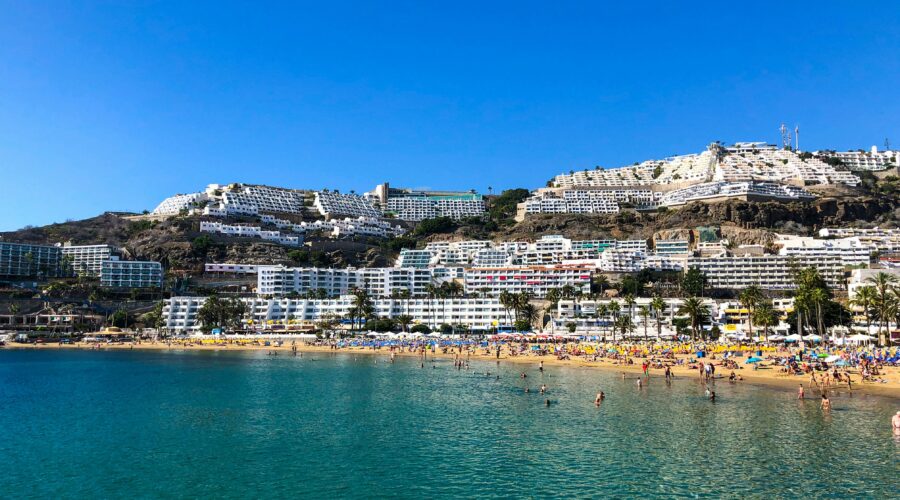
While the Canary Islands are often discussed as a single destination, tourism pressure is highly concentrated in specific micro-regions. In Tenerife, for example, the southern corridor — including areas such as Adeje and Arona — accounts for a disproportionate share of total visitor nights, driven by large-scale resort development and short-term rental expansion.
This spatial imbalance means that while some inland or less-developed areas remain relatively untouched, coastal zones experience infrastructure strain that is significantly higher than regional averages suggest. Transport networks, water supply systems, and housing markets in these high-density areas are therefore under far greater pressure than island-wide figures alone would indicate, creating sharp contrasts between tourist zones and residential inland communities.
The Bigger Question
The Fodor’s “No List” does not target the same destinations every year. It changes depending on where tourism pressure is most acute.
For the Canary Islands, the long-term outcome will depend on policy decisions, development strategies, and the collective choices of millions of travelers.
The protests in 2024 were not asking for tourism to stop. They were asking for it to change.
Not sympathy — but attention.
Travel that understands a place as a living system, not just a backdrop for consumption.
That is where sustainable tourism begins. And it starts with being honest about what the current trajectory looks like — and what it would take to change it.