
Karijini Eco Retreat: Beyond the Red Earth in Australia’s Most Remote Region
How Your Stay Supports the People of the Pilbara Region
This article explores how your choice to stay at an eco-retreat in the Pilbara region — a vast, remote area in Western Australia stretching across thousands of kilometres of red earth, ancient landscapes, and Indigenous territories — can directly support the Aboriginal communities who call this region home. With thousands of years of cultural heritage and deep spiritual connections to the land, the Pilbara is one of Australia’s most unique and least understood regions. When you choose an eco-stay here, your visit supports these communities economically, helps preserve their cultural traditions, and contributes to protecting one of the world’s most extraordinary natural environments.
Author: Emily Carter
In collaboration with: Karijini Eco Retreat
Karijini National Park’s ancient landscape
Here, you’ll discover some of the world’s oldest natural formations, dating back an astounding 2.5 billion years! Whether it’s hiking through towering gorges, marvelling at plunging waterfalls, or dipping into the park’s tranquil pools, the beauty of the Pilbara outback is a sight to behold. And at Karijini Eco Retreat, you’ll experience all this from the comfort of your very own eco-tent.
In the heart of the spectacular Karijini National Park lies more than a getaway destination – it’s a place where meaningful travel meets natural wonder.
At Karijini Eco Retreat, your stay directly supports the lives and futures of the Banjima, Yinhawangka, and Nyiyaparli people of the Pilbara region.
It’s owned by Gumala Enterprises Pty Ltd (GEPL), and the unique retreat exemplifies how tourism can drive social empowerment and economic growth, transforming each guest’s visit into an act of mindful travel and community support.

The Pilbara and the Three Nations Who Call It Home
The Pilbara is a vast, remote region in north-west Western Australia. It stretches across thousands of kilometres of ancient landscape, red earth, and sparse settlements. For thousands of years, it has been home to the Banjima, Yinhawangka, and Nyiyaparli people. These are three distinct language groups, each with their own culture, stories, and connection to Country.
Today, the Pilbara is known for its mining industry and its natural beauty. But for the people who have lived here since before European arrival, it is something deeper: ancestral land, cultural identity, and home.
Karijini Eco Retreat is one example of how Gumala is putting that vision into practice.
Tourism That Stays in the Community
Choosing Karijini Eco Retreat means your money goes somewhere specific. A portion of the profits from each stay is directed toward essential programs in Indigenous communities: education and training, cultural preservation, and infrastructure projects.
This is different from many tourism businesses, where profits flow to distant shareholders. Here, the benefits stay in the Pilbara. They support the people whose Country attracts visitors in the first place.
That matters because it links a visitor’s experience to long-term community priorities. It also keeps the impact story grounded in something real: not vague promises, but practical support connected to actual programs and outcomes.
The 3a Early Learning Program: Building Futures in the Pilbara
One of the programs supported through Gumala is the 3a Early Learning Program. With seven locations across the Pilbara, it reaches young children in communities where access to quality education can be harder to find.
The 3a program is described as more than early education. It is designed to empower young minds with the skills and confidence they need to thrive. The program is grounded in cultural identity and family involvement. It supports a love for learning while strengthening the connection between children, their families, and their heritage.
In a region where distance can make access to services harder, early learning becomes more than a classroom concept. It becomes a foundation. Every lesson, story, and interaction helps build toward lifelong success, and supports the next generation in carrying forward the strength and knowledge of the Banjima, Yinhawangka, and Nyiyaparli people.

Gumala’s Vision
Gumala is one of Australia’s largest Aboriginal corporations, representing the Banjima, Yinhawangka, and Nyiyaparli people of the Pilbara region in Western Australia. With offices in Boorloo (Perth) and Jarndunmunha (Tom Price), Gumala is dedicated to empowering Traditional Owners through initiatives that support education, employment, business development, and cultural preservation.
Projects like the Karijini Eco Retreat exemplify Gumala’s commitment to strengthening the connection between the three language groups and their ancestral lands while fostering a brighter future for generations to come.
Staying at the Edge of Joffre Gorge
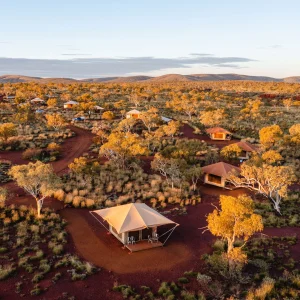
The retreat’s safari-style tents are described as cosy and comfortable. They offer private bathrooms, king-sized beds, and daily breakfasts. The location is part of the experience. Guests can wake to sunlight on red cliffs, then step into a day shaped by the park.
For those who want more context, guided tours are available as a way to deepen connection with the environment. This kind of stay is not about separating visitors from the landscape. It is about creating a base that makes exploration easier, while still keeping the feeling of being in nature.
Continental and cooked breakfasts are served with views. Packed picnic lunches are available for outback adventures. Meals at the retreat’s outback-style restaurant are inspired by local ingredients. Food is often where travel becomes personal. It is where a day of hiking turns into an evening of conversation. It is where the landscape becomes a memory you can taste.


How Karijini Eco Retreat Reduces Its Impact
Karijini Eco Retreat describes a commitment to authentic nature-based accommodation and eco-friendly experiences. The retreat runs on majority solar power to help minimise its carbon footprint. Water is sourced from onsite bores, and usage is monitored regularly.
The retreat also states it has an environmentally friendly wastewater plant that allows greywater to be used to rejuvenate surrounding native bushland. The eco tents are described as semi-permanent structures designed to leave minimal impact on the environment. They are designed for natural ventilation and require minimal power usage.
This is the kind of sustainability that fits the realities of a remote national park.
Verified Commitments: Accreditations That Matter
Karijini Eco Retreat is an active member of Ecotourism Australia and holds Advanced Ecotourism Certification. The retreat is also working toward Sustainable Tourism Certification with Ecotourism Australia and has completed the Strive 4 Sustainability Scorecard with a score of 80%.
It has joined the Tourism Emission Reduction Program and, with the support of ERC Australia, has committed to decarbonise operations, with an Emissions Reduction Plan available via its sustainability information. Through the national Quality Tourism Framework, the retreat also holds EcoStar and Sustainable Tourism Accreditations.
For a conscious traveller, these details matter because they show external frameworks and a willingness to measure progress. They also make the story easier to trust.
Embrace the essence of the Australian Outback
From continental breakfasts served with stunning views to packed picnic lunches perfect for an outback adventure, Karijini Eco Retreat provides everything you need to explore the park in style. As the day winds down, enjoy a meal inspired by local ingredients at the retreat’s outback-style restaurant.
When you stay at Karijini Eco Retreat, your choice directly supports the communities and programs you’ve read about here. It’s a way to experience one of Australia’s most remarkable landscapes while knowing your visit makes a real difference.
Embrace the outback like never before and visit Karijini Eco Retreat for your immersive glamping experience.

View This Eco-Stay
Karijini Eco Retreat