
Kasbah du Toubkal: Morocco’s Mountain Retreat
Stronger, Lighter, More Connected — Kasbah du Toubkal After the Rebuild
High in Morocco’s Atlas Mountains, Kasbah du Toubkal offers what many eco-conscious travellers seek: authentic connection, slow rhythm, and a deep respect for the land and people. Written by Mike McHugo, one of the Kasbah’s founders, this story shares how this iconic retreat was rebuilt after the 2023 earthquake — stronger, lighter, and more open than before. Discover the gardens that invite you to pause, the rooftop views that take your breath away, the Amazigh hospitality that feels genuine, and easy ways to trek, rest, and belong in a place that cares as much about its community as it does about its guests.
Author: Mike McHugo

Kasbah du Toubkal has always been the kind of place that makes you slow down without asking. You arrive on foot from Imlil, step through the gate, and the pace changes instantly. Flowers soften the stone. Rosemary perfumes the air. White canvas deckchairs wait on the lawn like an invitation to do less.
And for returning guests, so much still feels familiar.
But step inside the Kasbah today and you’ll sense something deeper than a simple renovation. After the earthquake that struck Morocco’s High Atlas Mountains on September 8th, 2023, Kasbah du Toubkal faced a moment no one could have imagined — then chose to rebuild with intention. What emerged is not a different Kasbah, but a stronger one: more open, more light-filled, and even more connected to the valley and the people who call it home.
Same, same — but different
After passing through the main gate and strolling up the crazy-paved path, previous guests might at first think little has changed. The hammam is still there. The “room with a view” still earns its name. The garden still feels like a quiet, green pause between mountain walks.
A new carved wooden door, framed by a traditional horseshoe arch, and two new windows where mesh once stood could easily be read as a tasteful upgrade — one more detail in a place already rich with craft.


But that doorway marks a new chapter.
When I and my brother Chris McHugo found ourselves almost at the epicenter of the quake, our first thought was our guests. Everyone was safe. Only later did the scale of the damage reveal itself: reception, dining room, kitchens, and much of the iconic belvedere were reduced to rubble in seconds.
Obviously it was a horrible event, and for some people devastating, especially as earthquakes are almost unheard of here. But whilst we didn’t appreciate it the next day, it turned out to be a blessing in disguise because it caused us to redevelop Kasbah.
Even before the earthquake, one key idea had been under discussion: opening the rear wall of the dining room to create an unobstructed view over the Aït Souka Valley. The quake removed that wall — and much of the structure — making old plans irrelevant and new possibilities unavoidable.
The part of the Kasbah that was affected was originally developed for school groups, not as a boutique hotel, which is what we’ve become. We don’t take any school groups now so it’s allowed us to rebuild the dining rooms, the roof terrace, and the central areas without the dormitory-cum-family rooms that surrounded the old dining room that weren’t appropriate any longer.
In other words: the heart of the Kasbah could be rebuilt to match what the Kasbah has truly become — an iconic mountain retreat for travellers seeking beauty, calm, and meaning.
A Pool With A View And A Kasbah That Breathes

Architect John Bothamley — recognised for his understanding of vernacular architecture and involved with the Kasbah from early on — arrived in Imlil the following week. The priority was clear: understand what had to be demolished, what could be saved, and how to rebuild in a way that respected the Kasbah’s identity while improving the experience.
Light and views became central. So did flow.
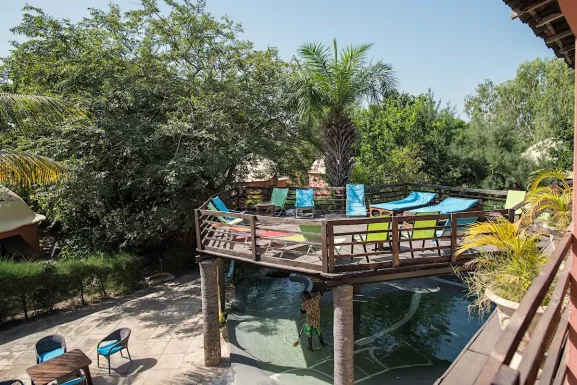
Today, the most visible external changes sit at the back of the Kasbah: an oval swimming pool and a three-storey tower. From certain angles, the tower appears taller than before — but in reality, it isn’t. The difference is that it now sits on the edge of the development, making it feel more dramatic against the mountain backdrop.
On the ground floor, archways beside the pool are open, making the Kasbah feel airy and expansive. Views stretch outward — toward water, stone, valley, and sky.


Inside, the new layout creates more choice:
– Reception rooms with doors opening onto terraces
– An open courtyard looking onto the pool
– Dining downstairs in the restaurant or upstairs on the roof terrace
– A private dining or meeting room with arched windows
– The beloved belvedere under its green tiled roof, still offering 360° views
The main dining room seats forty-plus, while the roof terrace has been levelled and enlarged to host special functions for over one hundred guests.
And because mountain seasons are real seasons, the rebuild also added reception rooms with log-burning stoves — small details that make winter stays feel not just possible, but deeply cosy.
The roof terrace remains the favourite place for lunch, especially in summer. But now there’s something new: a swimming pool with beautiful views over Aït Souka and the surrounding peaks — an irresistible contrast to the heat of Marrakech.

Why Kasbah Du Toubkal Feels Restorative And Consequential
Kasbah du Toubkal is often mentioned in roundups of the world’s most extraordinary high-altitude hotels — and once you’re here, it’s easy to understand why. Yes, the views are huge. But the real magic is quieter: the feeling that your time in the High Atlas is both good for you and good for the place.
Many guided walks and treks toward Jebel Toubkal (North Africa’s highest peak) begin with mint tea in Imlil. It’s a simple moment, but it sets the tone: slow down, breathe, and arrive properly. After a day on the trails, you come back to hand-woven blankets, warm light, and a tagine on the table — and it hits you that travel can be restorative without being wasteful.
Large Groups Exclusive Rentals And Mountain Gatherings
Kasbah du Toubkal has a long history of hosting large groups: business meetings, residential courses (yoga, trekking, painting), and families or friends celebrating milestone moments.
With fifteen bedrooms, the Kasbah can be taken as an exclusive rental for up to thirty guests sharing rooms — ideal for private retreats with a sense of place.
My approach is: think big, and spread the load. Because of the group size and the complexity of planning, August was the earliest feasible window. Some guests practised yoga and mindfulness early in the morning.
Why This Place Stays With You
Some eco-stays impress you. Others change your rhythm. Kasbah du Toubkal sits in that rare category of places that feel both deeply rooted and quietly visionary. It’s a sanctuary for travellers, but also a living part of the Imlil Valley — shaped by Amazigh culture, mountain seasons, and a kind of hospitality that isn’t performative.
Guests often mention:
- The calm of the gardens and courtyards
- The warmth and care of the Berber staff
- The feeling of being “held” by the mountains
- The way the Kasbah blends tradition with comfort
- The simple joy of mint tea, tagine, and rooftop views
And now, with its new open spaces and pool overlooking the valley, the Kasbah offers even more reasons to stay a little longer.


View This Eco-Stay
Kasbah du Toubkal